
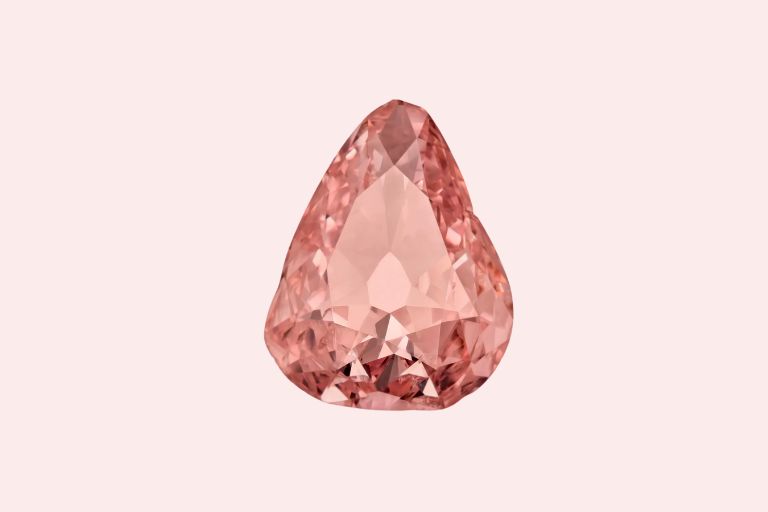
A rare 9-carat pink diamond stolen almost 100 years ago is returning to public display in France. The story offers gem businesses a close look at how rarity, history and proof of identity can add value to an exceptional stone.
Known as the Grand Condé, the pear-shaped diamond disappeared during a night raid at the Château de Chantilly in October 1926.
The thieves reportedly hid the diamond inside a hollowed-out apple. A few weeks later, a hungry maid at their hotel took a bite of the apple. That led to the diamond’s recovery.
The story may sound hard to believe. However, museum director Mathieu Deldicque said newspapers reported it at the time. The Grand Condé will now return to public view at the Condé Museum. The exhibition will run until 3 January.
Why rare pink diamonds attract high values
Natural pink diamonds are among the rarest coloured diamonds in the world. Top-quality stones can sell for tens of millions of dollars.
The highest auction price for a pink diamond reached $71.2 million in 2017, according to Sotheby’s. That figure does not mean the Grand Condé is worth $71.2 million. The museum has not revealed the diamond’s insurance value.
For gem businesses, the more useful lesson lies in what makes an exceptional stone valuable.
Colour and carat weight matter. But so do a stone’s history, ownership records and proof of identity. The Grand Condé has a long history that can be traced back more than 280 years.
The diamond first appeared in a 1740 inventory after the death of Louis Henri de Bourbon, Prince of Condé.
It later became part of the collection of Queen Marie-Amélie of Bourbon-Sicily, the wife of French King Louis Philippe I. Her son, Prince Henri of Orléans, Duke of Aumale, later owned the diamond.
He eventually left it to the Institut de France, which now owns the Château de Chantilly.

Science helps protect the diamond’s identity
The diamond’s exact origin remains unknown. However, researchers have studied its physical properties in detail. The work has helped create a way to identify the Grand Condé as a unique stone.
The museum will show the research as part of the new exhibition.
It will also display archive material about the diamond’s history and its 1926 theft. This has a clear lesson for the high-value gem trade.
A rare gemstone needs more than a high carat weight or an attractive colour.
Clear ownership records, historical evidence and reliable identification can also add value and help protect a stone.
The exhibition comes at a time when several European cultural institutions have faced high-profile thefts. The Louvre in Paris, for example, recently suffered a daylight jewellery robbery.
That has raised questions about the decision to display the Grand Condé again. Deldicque has not revealed how much the museum has insured the diamond for.
For gem businesses, however, the return of the Grand Condé offers a bigger lesson.
A rare stone can carry financial and historical value for generations when its identity, ownership and story remain well documented.

Last modified: October 18, 2026