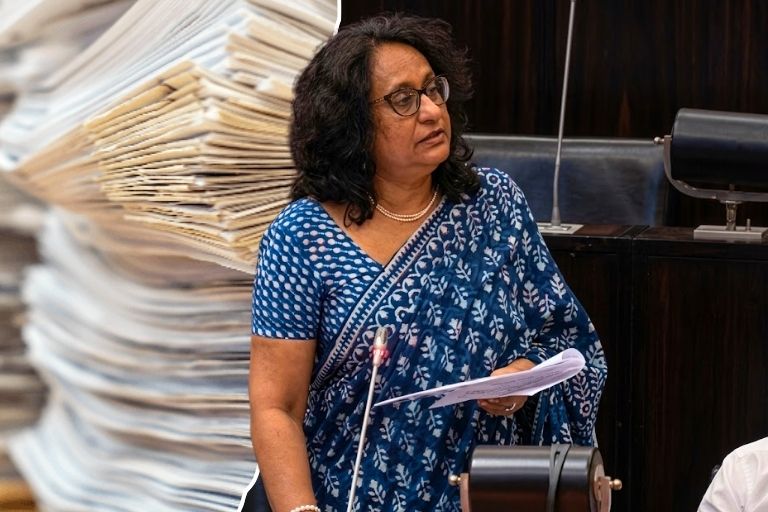
Parliament spent Rs.73.1 million in 2025 on printed materials provided to MPs and ministers, as the government works to reduce paper use through digital systems.
Prime Minister Dr. Harini Amarasuriya disclosed the figures in Parliament on September 10 while responding to a question about digitalisation and paper use.
The spending covered Hansard reports, Order Books, Agendas and other printed materials used by MPs and ministers in the Chamber.
Parliament spent Rs.45.3 million in 2023 and Rs.58.7 million in 2024 on the same materials. The annual cost therefore rose by Rs.27.8 million over the two-year period.
Parliament to Study Digital Documents
The Prime Minister said Parliament is now developing a programme to reduce paper use.
Following a request from the Secretary to the Treasury, the Committee on Parliamentary Business considered whether reports could be submitted to Parliament only in digital form in the future.
However, Parliament will first survey MPs to find out their preferences.
Based on the results, MPs who prefer digital copies will receive their documents electronically. Those who want printed copies will continue to receive them.
The Committee on Parliamentary Business will decide when to introduce the programme after completing the survey.
Government Moving More Work Online
Meanwhile, ministries and government institutions are also taking steps to reduce paper use through digital systems.
Dr. Amarasuriya said the process will take time. However, she expects digital systems to eventually support the exchange of files and many other government processes.
She pointed to the Ministry of Education as an example.
Previously, university lecturers submitted printed applications to the Ministry when seeking approval for overseas travel leave. The process has now moved online.
The Ministry, through the University Grants Commission, also provides approval through a digital process.
The Prime Minister said other ministries are taking similar steps and that wider use of digital systems should help reduce paper use across government.
New Learning Modules to Cut Schoolbag Weight
The Prime Minister also addressed the issue of heavy schoolbags and linked it to the new education reforms.
She said activity-based learning will reduce the amount of material students need to carry.
Under the planned approach, books will remain in classrooms. Students will not need to carry them between home and school each day and will take them home at the end of the term after completing their work.
In addition, a module-based learning system will begin for Grade 6 in 2027.
Instead of large textbooks, students will receive subject-specific modules for each term.
The change is expected to reduce the weight of schoolbags while supporting the new learning approach.
Parliamentary Updates Prime Minister’s Office
Last modified: September 11, 2026