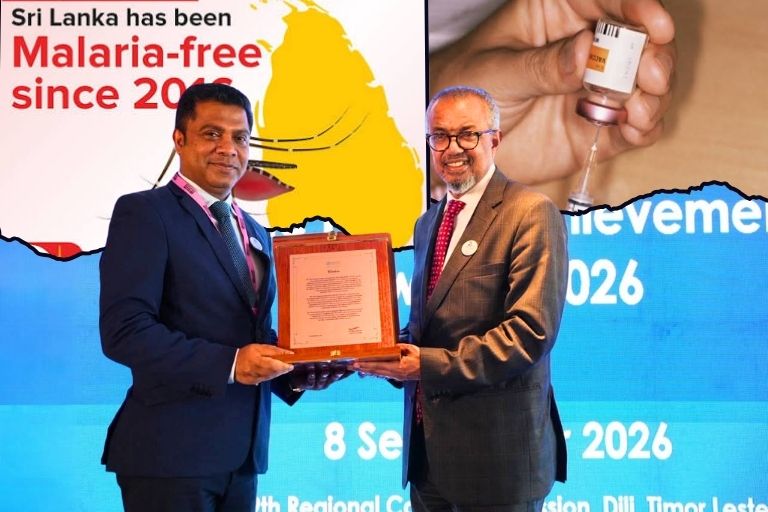
Sri Lanka has received special recognition from the World Health Organization (WHO) for maintaining its malaria-free status and sustaining the elimination of maternal and neonatal tetanus for 10 years.
WHO Director-General Dr Tedros Adhanom Ghebreyesus presented the citation to Health and Mass Media Minister Dr Nalinda Jayatissa during the 79th session of the WHO Regional Committee for South-East Asia in Dili, Timor-Leste.
When did WHO certify?
The country was certified malaria-free by WHO in 2016. It became the second country in the WHO South-East Asia Region, after the Maldives, to achieve malaria elimination.
Since then, it has maintained that status by preventing the reintroduction and spread of the disease. The last indigenous malaria cases were recorded in 2012.
The country has also maintained the elimination of maternal and neonatal tetanus for a decade, supported by continued immunization of pregnant women.
WHO attributed these achievements to the primary healthcare system, national commitment, high immunization coverage, and disease surveillance and control mechanisms.
The organization said these efforts have helped protect public health and support a healthier future for coming generations.
More:
Musthapha Urges Parliament to Fast-Track Under-16 Social Media Bill
Awards & Recognitions Certification & Recognition Healthcare
Last modified: September 9, 2026