A new generation of space research infrastructure is set to reshape the global astronomy industry, with the California Institute of Technology (Caltech) moving ahead with one of the world’s most ambitious radio telescope projects.
The project, known as the Deep Synoptic Array (DSA), has secured funding and is expected to become the most powerful ground-based radio telescope system ever built. Researchers say it could dramatically increase the number of known radio sources in the universe and create new opportunities for scientific discovery.
The development highlights growing investment in large-scale science and technology projects, as institutions and private funders continue to back advanced research infrastructure.
1,650 Antennas to Create World’s Most Sensitive Radio Array
The Deep Synoptic Array will consist of 1,650 radio dishes spread across more than 123 square miles in Nevada’s White Pine County.
According to Caltech, the telescope will study supermassive black holes, pulsars and fast radio bursts, which are among the most mysterious phenomena in the universe.
“It’s the sheer number of antennas that makes this completely unique and unlike other existing telescopes,” said Gregg Hallinan, a professor of astronomy at Caltech and a principal investigator for the Deep Synoptic Array.
Hallinan said the telescope is expected to outperform existing ground-based radio observatories by surveying the sky 100 times faster while producing sharper images.
“Every telescope that has been built in history — and that’s going back a century — combined has found about 20 million radio sources,” he said.
“That’s how many radio sources we know of in the universe. This telescope will double that in the first 24 hours.”
Science Infrastructure Meets Big Investment
Funding for the project comes from Schmidt Sciences, a philanthropic organisation established by former Google CEO Eric Schmidt and his wife, Wendy.
The investment reflects increasing private-sector involvement in large-scale scientific research, a trend that has accelerated across the space, technology and artificial intelligence sectors.
Construction is expected to begin next year, subject to regulatory approvals, with completion targeted for 2029.
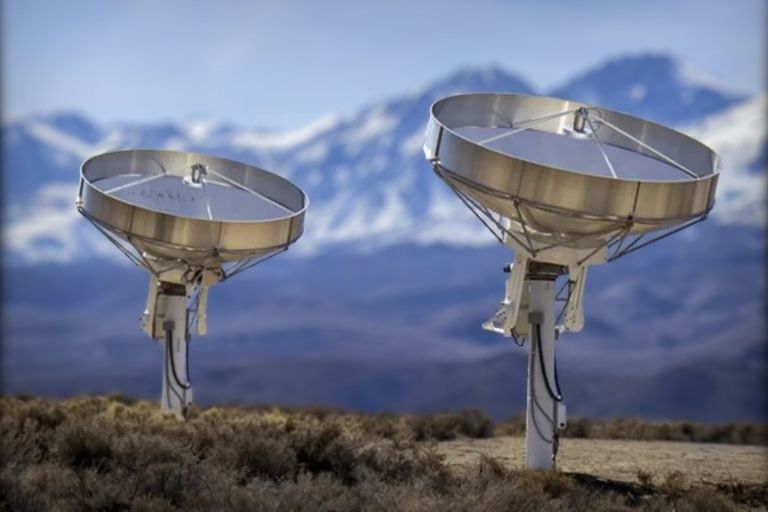
Researchers recently completed two prototype dishes near Bishop, California, as part of the project’s technology testing phase.
Why Nevada Was Chosen
Selecting the right location was critical because radio telescopes are highly sensitive to interference from mobile phones, Wi-Fi networks and electronic devices.
“This telescope is sensitive enough to detect a cellphone as far away as the sun,” Hallinan said, “so we need to try to get away from all that.”
After evaluating sites across California, Nevada, New Mexico and Utah, researchers selected Nevada’s Great Basin region due to its low population density and exceptionally quiet radio environment.
“There are these quiet valleys that are also very low in population,” Hallinan said.
“This location in White Pine County was by far the quietest that we found, and it was just incredibly well-suited for radio astronomy.”
New Era for Radio Astronomy
Researchers believe the Deep Synoptic Array could transform the way scientists study the universe.
“Radio astronomy is about to go from sketch to photograph,” Vikram Ravi, a professor of astronomy at Caltech and a co-principal investigator for the Deep Synoptic Array, said in a statement.
“The DSA is looking at a far larger volume of the universe far more often than any other telescope.”
Once operational, the telescope will help identify radio signals from distant cosmic objects and guide optical, infrared and X-ray observatories toward new areas of research.
For the global science industry, the project represents another example of how advanced infrastructure and private funding are accelerating the pace of discovery.
Last modified: June 23, 2026