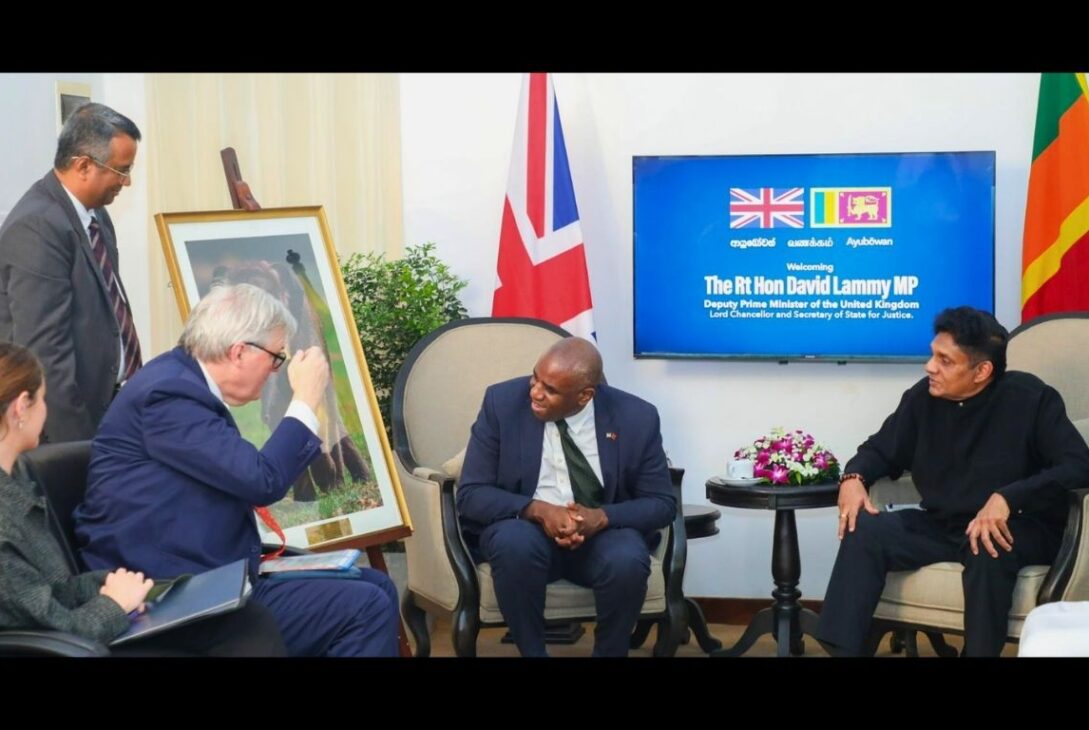
Sajith Premadasa held wide-ranging discussions with David Lammy, Deputy Prime Minister of the United Kingdom, during a meeting in Colombo, focusing on democratic governance, trade expansion and humanitarian cooperation.
Governance, Accountability and Reform
Premadasa acknowledged the reformulation of Official Development Assistance, particularly in governance, rule of law, climate justice and poverty alleviation. He emphasized the principle of “progressive realism,” which balances democratic values with practical economic solutions that directly benefit citizens.
He welcomed the UK’s leadership in global anti-corruption initiatives, including its presidency of the Group of States against Corruption (GRECO) and its Anti-Kleptocracy Campaign. Strengthening accountability mechanisms, he noted, remains essential to restoring public trust and ensuring long-term economic recovery.
Discussions also covered legislative developments, including the proposed Protection of the State from Terrorism Act (PSTA) and amendments to the Online Safety Act. Premadasa cautioned against overly broad definitions of terrorism that could affect political dissent or trade union activity. He stressed that judicial oversight must guide legal interpretation and that online regulation should align with international norms while safeguarding civil liberties.

Expanding Sri Lanka–UK Trade Relations
Trade cooperation formed a central pillar of the dialogue. The UK remains Sri Lanka’s second-largest export destination.
Total bilateral trade in goods and services reached approximately £1.7 billion for the four quarters ending Q3 2025, marking a 10.2% year-on-year increase. Sri Lankan exports to the UK totalled £1.2 billion, with apparel contributing 73%.
Premadasa welcomed the UK’s Developing Countries Trading Scheme (DCTS), which introduced liberalised Rules of Origin effective January 1, 2026. Under the scheme:
-
Over 92% of Sri Lankan product lines qualify for duty-free access.
-
Apparel manufacturers can source 100% of raw materials globally while retaining zero-tariff entry.
-
The removal of the “double transformation” rule reduces compliance costs, particularly for MSMEs and startups.
-
Regional cumulation allows manufacturers to use inputs from 18 Asia Regional Cumulation Group countries.
The leaders also discussed Sri Lanka Expo 2026 as a platform to diversify exports into rubber products, ethical fashion and high-value niche goods.
Humanitarian Solidarity and Strategic Engagement
Premadasa conveyed appreciation for the UK’s “Sovereign Solidarity” following Cyclone Ditwah. The UK increased its humanitarian aid to £1 million in December 2025. The funding, channelled through the Red Cross and UN agencies, supported emergency shelter, sanitation facilities, medicines and food supplies for 1.8 million affected people.
He also acknowledged the message of condolence from King Charles III, describing it as a reaffirmation of longstanding ties.
Environmental and Biodiversity Cooperation
The Opposition Leader proposed enhanced bilateral cooperation to address the human–elephant conflict. He highlighted the need for scientific land-use planning, sustainable conservation strategies and international technical support to protect biodiversity while safeguarding rural livelihoods.
Intellectual Engagement
Premadasa congratulated Lammy on his published works, including Out of the Ashes and Tribes, noting that their themes on social cohesion offer valuable lessons for reconciliation and nation-building.
The meeting reaffirmed strong bilateral relations and underscored opportunities for deeper economic, institutional and environmental cooperation between the two countries.


More Stories:
Government to get US$50 Million from World Bank for Digital Transformation
Last modified: February 18, 2026