A large share of young people with higher education are struggling to find jobs in Sri Lanka.
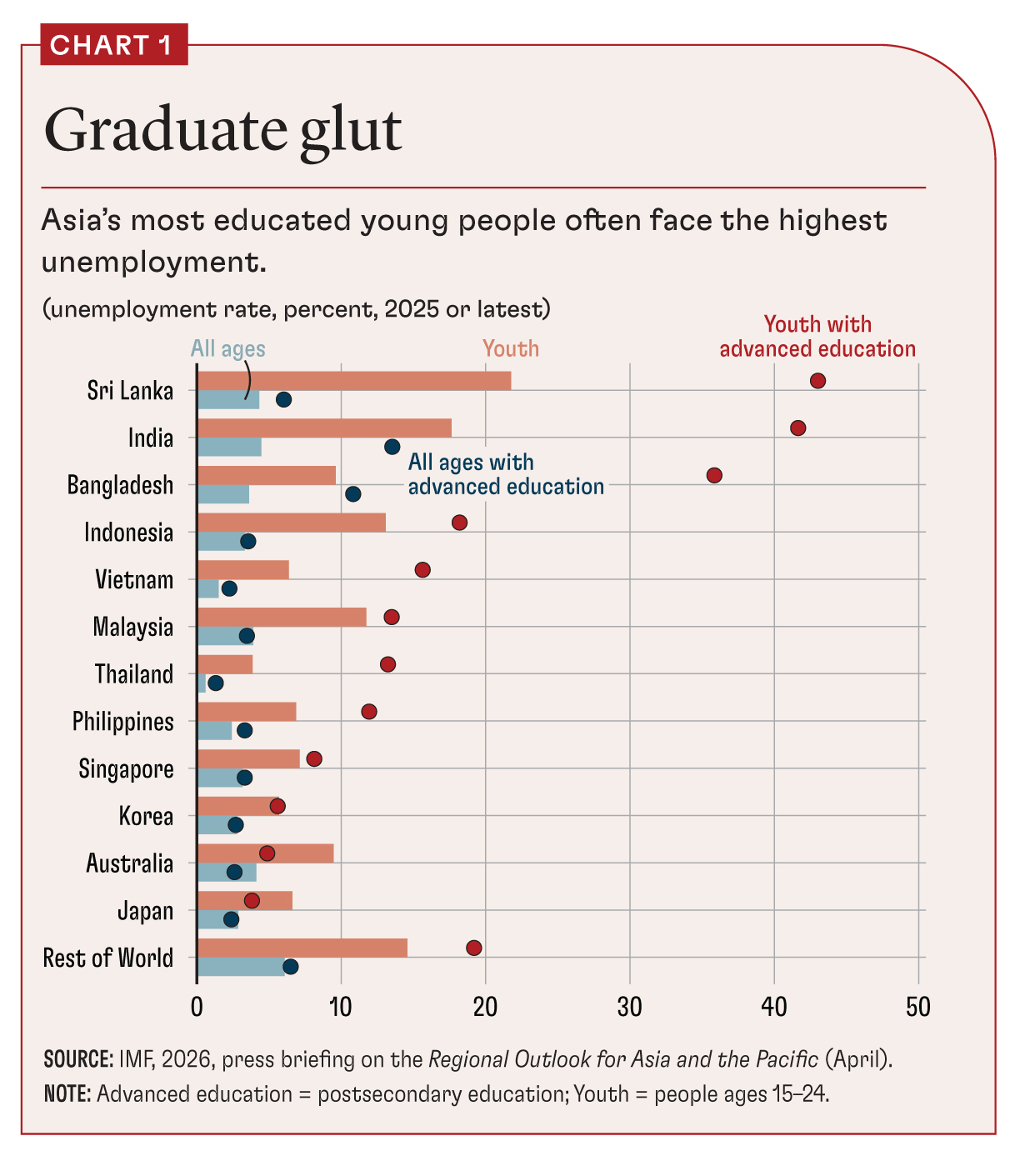
New research published by the International Monetary Fund shows that joblessness among people aged 15 to 24 with postsecondary education has reached 43%.
The rate is the highest cited in the IMF’s South Asian comparison. The research shows educated youth unemployment at about 36% in Bangladesh, while Sri Lanka reaches 43%.
The numbers point to a problem that goes beyond the lack of jobs.
They raise questions about whether young people are leaving universities and other higher education programmes with the skills employers need.
When Education Does Not Lead to Employment
The IMF says highly educated young workers across Asia are struggling to find jobs that match their qualifications.
Krishna Srinivasan, Director of the IMF’s Asia and Pacific Department, has pointed to a persistent mismatch between education and labour market needs.
This creates a difficult situation for both graduates and businesses.
A young person can spend years gaining a degree but still struggle to enter the job market.
At the same time, employers can have vacancies while finding it difficult to recruit people with the right skills.
This gap has an economic cost.
When young people remain outside productive employment, the economy does not fully use the human capital it has already invested in.
Businesses also lose potential workers who could build skills, gain experience and contribute to productivity.
AI Could Change Entry-Level Jobs
The problem is becoming more complex as companies adopt artificial intelligence.
AI can help businesses increase productivity and create new opportunities. But the IMF warns that it could also increase pressure on young workers if technology develops faster than skills.
Entry-level jobs are especially important in this discussion.
Graduates often begin their careers by handling tasks that help them learn how businesses work. They then build experience and move into more complex roles.
If technology takes over some of these early tasks, young workers may have fewer opportunities to gain that first experience.
This does not mean AI will simply remove jobs.
The bigger issue is whether education and training can change fast enough to prepare workers for the jobs that technology creates and changes.
The Business Problem Is Also a Skills Problem
For businesses, the issue is not only how many people are available for work.
It is whether those people have the skills needed to create value.
This makes universities, technical colleges and employers part of the same conversation.
Education programmes need to understand how jobs are changing. Businesses also need to help define the skills they need.
The IMF has called for universities and technical programmes to become more responsive to employer demand and for graduates to gain skills that firms actually need.
That could mean greater focus on practical training, digital skills, communication, problem-solving and industry experience alongside academic qualifications.
Sri Lanka’s Human Capital Challenge
Sri Lanka has already invested heavily in education over many years.
The next challenge is turning that education into productive employment.
A 43% joblessness rate among young people with postsecondary education shows that a degree alone does not guarantee a successful entry into the labour market.
For the economy, the goal should therefore be more than producing graduates.
It should be producing graduates who can find productive work, adapt to technology and help businesses grow.
The AI transition makes this challenge more urgent.
If education and training move slowly while technology changes quickly, the gap between what young people learn and what businesses need could become wider.
But if skills development keeps pace with technology, the same transition could create new opportunities for productivity, entrepreneurship and higher-value employment.
The question is no longer simply whether young people are getting educated.
It is whether that education is preparing them for the economy they are entering.
International Monetary Fund (IMF)
Last modified: September 21, 2026