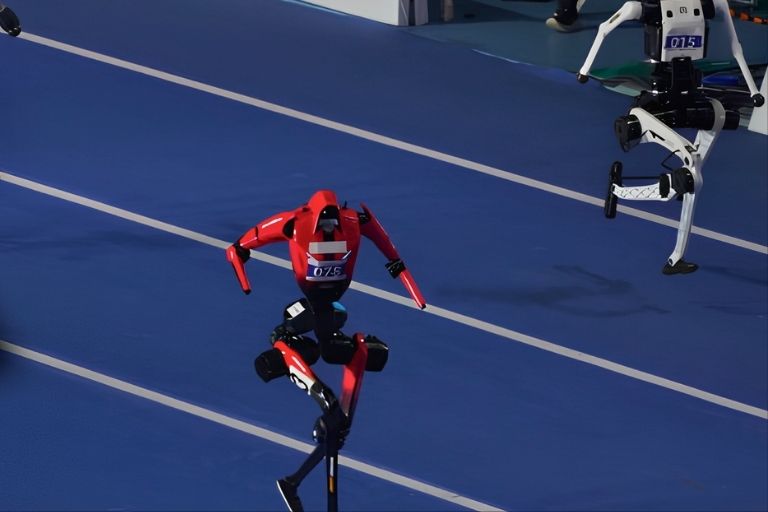
A Chinese humanoid robot has run 100 metres in 9.32 seconds, beating Usain Bolt’s official human world record in a test ahead of a major robot sports competition in Beijing.
The robot, named Lightning, reached a reported peak speed of 14.5 metres per second, according to Chinese smart-device maker Honor and CGTN.
Bolt set the official human 100m world record of 9.58 seconds at the 2009 World Championships in Berlin.
But Lightning’s time is not a new athletics world record. Human and robot performances follow different rules, so the two times are not directly comparable under World Athletics regulations.
A robot built for the track
Lightning is expected to compete in the 100m, 400m and 1,500m races at the second World Humanoid Robot Games.
The five-day competition runs in Beijing from August 22 to 26.
Humanoid robots will compete in several sports, including long jump, weightlifting and table tennis.
The events give robotics teams a way to test how their machines perform under physical pressure rather than only in controlled demonstrations.
For the companies developing these machines, speed is only one part of the challenge. Robots also need to maintain balance, control their movements and complete tasks reliably.
From AI software to physical machines
Lightning’s reported sprint adds to the growing focus on humanoid robots that can perform physical tasks.
The robot’s 9.32-second run does not replace Bolt’s record. However, it shows how robotics developers are testing machines against demanding human physical activities.
The World Humanoid Robot Games will provide another test as teams bring robots from around the world to compete in different sports.
For the robotics industry, the bigger question is no longer only whether AI can think or respond. It is increasingly whether machines can move, react and perform in the physical world.
Last modified: August 23, 2026