Sri Lankan government has reached a staff-level agreement with the International Monetary Fund (IMF) on the Seventh Review of its economic reform plan, marking another step forward in the country’s economic recovery. The agreement could give Sri Lanka access to about US$345 million in additional IMF financing once the IMF Executive Board approves the review and the required conditions are met.
IMF staff and Sri Lankan authorities reached the agreement after discussions on the country’s four-year Extended Fund Facility (EFF). The talks also covered the 2026 Article IV Consultation.
IMF Mission Chief for Sri Lanka Evan Papageorgiou said the economy has remained resilient despite a series of external shocks.
“Sri Lanka’s economy has proved remarkably resilient to successive shocks,” Papageorgiou said. He added that continued reforms and careful economic policies will help protect the progress already made and support stronger, inclusive growth.
US$345 Million Within Reach
Under the latest agreement, Sri Lanka could receive SDR 254 million, worth about US$345 million, after the IMF Executive Board completes its review. That would take total IMF financial support provided under the current arrangement to SDR 2.032 billion, or about US$2.7 billion.
The IMF Executive Board approved the four-year EFF arrangement in March 2023. It has a total value of SDR 2.3 billion, or about US$3 billion. Sri Lanka must still complete two important steps before the Board can approve the Seventh Review.
The Finance Minister must present the 2027 Budget to Parliament in line with the agreed economic parameters.
Sri Lanka must also complete a review of financing assurances. This will confirm financing contributions from multilateral partners and assess progress with debt restructuring.
Only after the Executive Board approves the review will the latest financing become available.
Economy Records 11th Consecutive Quarter of Growth
Recent figures show that economic activity continues to expand. Sri Lanka’s economy grew 4.2% year-on-year in the second quarter of 2026. This marked the 11th consecutive quarter of growth.
Headline inflation stood at 8% year-on-year in September, keeping price growth in single digits.
Gross official reserves reached US$6.9 billion at the end of August 2026. Banks remain well capitalized and profitable, according to the IMF. Fiscal performance during the first half of 2026 was also strong. Debt restructuring is largely complete, giving the economy a solid base for the next stage of recovery. These figures point to an economy that has continued to expand while rebuilding its financial buffers.
Fuel Prices Remain Part of the Economic Framework
Alongside the positive economic indicators, the IMF has highlighted the importance of maintaining a sustainable energy pricing system. The prolonged war in the Middle East has created uncertainty around international energy prices. Global trade policy and possible El Niño effects add further risks to the economic outlook.
Against this backdrop, the IMF has called on the government to allow domestic fuel prices to adjust in line with international fuel price movements.
It also wants Sri Lanka to maintain cost-recovery energy pricing while protecting vulnerable households.
“The government should allow domestic fuel prices to adjust in line with international fuel price movements and preserve cost-recovery energy pricing, while protecting the vulnerable,” Papageorgiou said.
This approach does not mean that fuel prices must always rise. Instead, domestic prices would continue to reflect changes in international fuel markets.
The IMF also stressed that support for households affected by higher energy costs should remain targeted.
Such assistance should stay within the budget, carry clear costs and have a defined time period.
Poverty-targeted cash transfers can help protect people who face the greatest pressure from higher living costs.
The Fund also called for better coverage and targeting of social safety nets.
Protecting Inflation Gains
Fuel prices can affect more than transport costs. Higher energy costs can feed into other parts of the economy and create wider price pressure. That makes inflation an important part of the IMF’s latest assessment.
Sri Lanka’s headline inflation was 8% in September.
If the Middle East conflict creates stronger second-round inflation effects, monetary policy should be ready to respond, the IMF said. Such action would aim to prevent inflation expectations from moving away from the Central Bank’s target.
The IMF’s message therefore combines two objectives: protect vulnerable households from external shocks while maintaining the price stability gains achieved during the recovery.
Stability Creates a Base for Investment
The latest IMF assessment places strong emphasis on moving beyond stabilization. Sri Lanka now needs to build on the economic stability achieved through its reform efforts. A medium-term revenue strategy is one area highlighted by the Fund.
Such a strategy could help sustain government revenue while improving the efficiency and fairness of the tax system. It could also give investors greater policy certainty. Public investment management is another priority.
The IMF wants Sri Lanka to address bottlenecks that slow capital spending. That includes efforts to speed up recovery and reconstruction following Cyclone Ditwah.
Greater exchange rate flexibility also remains important. According to the IMF, a more flexible exchange rate can help the economy absorb external shocks and support the accumulation of foreign exchange reserves.
Business Reforms Become More Important
The next phase of Sri Lanka’s economic recovery will depend not only on financial stability. Businesses also need an environment that makes it easier to invest, expand and reach new markets. The IMF has called for reforms covering several areas.
These include:
• Liberalizing trade
• Modernizing business regulations
• Modernizing labour regulations
• Expanding access to finance
• Advancing digital public infrastructure
• Closing infrastructure gaps
Better conditions in these areas can support investment, exports and employment.
For businesses, this represents a shift in focus from managing an economic crisis towards creating conditions for longer-term growth.
IMF Stresses Need to Protect Reform Gains
The IMF has identified several risks that could affect Sri Lanka’s recovery. The duration and intensity of the Middle East war remain uncertain. Global trade policy could affect external markets, while El Niño could create additional economic pressures.
Papageorgiou said Sri Lanka needs to maintain prudent policies and continue reforms to manage these risks.
“Safeguarding macroeconomic stability in a shock-prone environment requires continuing with prudent policies and bold reforms to protect the hard-won gains of the program,” he said.
The IMF also stressed the importance of preserving the integrity of the anti-corruption legislative framework. Maintaining public trust remains part of the broader reform agenda.
From Stabilization to Sustainable Growth
The Seventh Review agreement marks another stage in Sri Lanka’s economic recovery. Economic activity has continued to grow. Inflation remains in single digits. Foreign reserves have increased, while debt restructuring is largely completed.
At the same time, the country must continue working on revenue, investment, trade, business regulation, finance and infrastructure.
Papageorgiou said, “Staying the course on the broader reform agenda is critical to entrench stability and sustainably lift growth,”.
The IMF team visited Sri Lanka from September 10 to 23, 2026. It later held virtual discussions with senior officials to finalize the staff-level agreement.
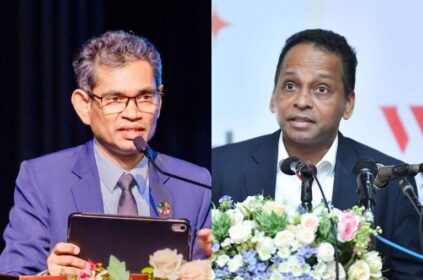
Those discussions included Central Bank Governor Dr P. Nandalal Weerasinghe, Treasury Secretary Dr Harshana Suriyapperuma, Senior Economic Advisor to the President Duminda Hulangamuwa, and other senior officials.
For Sri Lanka, the latest agreement provides another step forward under the IMF-supported economic reform process.
More importantly, it places the focus on what comes next: protecting economic stability while creating more space for investment, exports, businesses, and sustainable growth.
International Monetary Fund (IMF) Presidential Affairs
Last modified: October 5, 2026