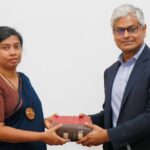
Rajeev Amarasuriya, President of the Bar Association of Sri Lanka (BASL), addressed the Supreme Court of India on 10 March, marking a rare and notable appearance by members of the Sri Lankan Bar before India’s apex court as part of an official delegation.
The event highlighted growing professional engagement between the legal communities of the two countries.
In a statement following the visit, Rajeev Amarasuriya expressed appreciation to Chief Justice of India Justice Surya Kant for extending the invitation.
The invitation was issued together with Supreme Court Justices R. Mahadevan and Joymalya Bagchi, who welcomed the Sri Lankan delegation during the visit.
The Chief Justice warmly received the delegation and reflected on the longstanding ties between the two countries. He also recalled his visit to Colombo in August last year, which further strengthened the relationship between the two legal communities.
The gathering also brought together several prominent figures in India’s legal system.
Among those present were Attorney General of India R. Venkataramani, Solicitor General Tushar Mehta, President of the Bar Association of India Prashant Kumar, and the President of the Supreme Court Advocates Association.
Strengthening Legal Cooperation
Addressing the court, Rajeev Amarasuriya described the occasion as a meaningful milestone in the relationship between the legal institutions of the two countries.
He noted that the appearance of Sri Lankan lawyers before the Supreme Court of India as part of an official delegation marked a historic moment in recent legal history.
The visit also reflected the deep professional ties between the Indian and Sri Lankan legal communities, which share common legal traditions and constitutional frameworks.
Amarasuriya highlighted that both countries have developed legal systems influenced by shared principles such as judicial independence, rule of law, and democratic governance.
Shared Historical and Cultural Links
During his remarks, the BASL President also referred to the long-standing historical connections between the two nations.
He noted that cultural and intellectual exchanges between the two countries date back more than two thousand years, particularly through the spread of Buddhism from India to Sri Lanka.
These historic ties, he said, continue to influence the values and institutions that guide both societies today.
He also emphasised that cooperation between legal institutions helps strengthen professional learning, jurisprudence, and institutional dialogue.
Expanding Regional Legal Engagement
The visit, Amarasuriya said, reflects the importance of continued engagement between legal professionals across borders.
He expressed hope that such exchanges will deepen collaboration between the Bench and the Bar of both countries, while contributing to the advancement of justice and the rule of law across the region.
For both legal communities, the moment represented not only a ceremonial engagement but also a renewed commitment to strengthening professional ties and institutional cooperation.
Last modified: March 11, 2026