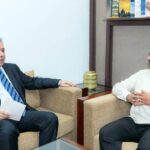
From modernizing fare payments in state-run buses to expanding rural road networks and launching new bus routes, the latest initiatives signal a coordinated effort to strengthen public transport and ease daily travel for communities nationwide.
Update on Kadawatha–Meerigama expressway section
Officials told the Minister that construction on the Kadawatha–Meerigama section has reached about 40 per cent completion.
Transport and Highways Minister Bimal Rathnayake inspected the construction work on Thursday. The Kadawatha–Meerigama stretch is the first phase of the Central Expressway project.
Authorities signed agreements for the project in 2015. Construction began in 2020 but stopped soon after. Officials said the suspension followed the economic crisis caused by policy failures.
After the new government took office, the Ministry of Transport resumed discussions with the Chinese government. These talks led to fresh loan approvals. Construction work restarted on September 17, 2025.
During the inspection, Minister Rathnayake asked officials to review earlier traffic studies. He focused on congestion risks at expressway entry and exit points. He also requested a fresh assessment of traffic flow on the Colombo–Kandy road once the expressway opens.
The Kadawatha–Meerigama section forms part of the wider Central Expressway. The project aims to improve connectivity between Colombo and the central regions. It also seeks to reduce travel time and strengthen the national road network.


Digital bus fare payment system launched
Government on Thursday rolled out a digital electronic bus fare payment system for state-run buses, marking a key step in efforts to modernize public transport services.
The pilot project was launched by the Ministry of Transport, Highways and Urban Development, with advisory support from the Digital Economy Ministry. The system is being implemented on buses operated by the Sri Lanka Transport Board.
Under the new system, passengers can pay bus fares using electronic cards. Officials said no additional charges will apply for card-based payments, and passengers will continue to pay only the standard fare for their journey.

The official launch took place at the Makumbura Multimodal Transport Centre, under the patronage of SLTB Chairman Engineer Sajeev Kanakaratne.
Authorities said the initiative aims to improve transparency between passengers and conductors, strengthen public transport operations, and enhance overall passenger convenience. Feedback and observations from the pilot phase will be used to refine the system before wider expansion.
The pilot became operational from Wednesday on selected routes, including Makumbura–Galle and Makumbura–Embilipitiya.
76 rural roads upgraded under “Punarudayata Maga” programme
Upgrading work on 76 rural roads across the country commenced on Thursday (01) under the “Punarudayata Maga” (Path to Renaissance) programme, aimed at improving living standards in rural communities and strengthening public transport access.

According to the Department of Government Information, the Ministry of Transport, Highways and Urban Development has allocated Rs. 5,000 million for the first phase of the project.
The programme focuses on improving connectivity between villages, easing access to markets and essential services, and supporting rural economic activity. Authorities said better road infrastructure is expected to reduce travel time and transport costs for rural communities.
In parallel with road upgrades, new bus services have been introduced on 40 rural routes that previously lacked public transport. These services also came into operation from today (01), improving mobility in underserved areas.

Transport Ministry reviews traffic fine demerit system roadmap
The Ministry of Transport has reviewed progress on the proposed traffic fine demerit system during a high-level meeting chaired by Transport Minister Bimal Rathnayake today.
The meeting brought together senior officials including the Inspector General of Police, representatives of the Postal Department, the Department of Motor Traffic (DMT), the Ministry of Digital Economy, and other key stakeholders.
According to the Ministry, the proposed demerit system aims to promote disciplined driving and improve road safety by identifying repeat traffic offenders. Under the system, drivers will receive penalty points for traffic violations. Those who reach the maximum limit may face penalties such as licence suspension or cancellation.
Officials discussed the legal, technical, and operational requirements for implementation. These include coordination between the Police, DMT, postal services, and digital platforms to support enforcement, data sharing, and public notification.
Authorities noted that the system has not yet been implemented. Preparatory work is ongoing, including the evaluation of bids submitted for the required technology infrastructure. Public awareness campaigns and consultations are planned ahead of a phased rollout.
Bailey Bridge opens on Badulla–Spring Valley road
The temporary Bailey Bridge constructed on the Badulla–Spring Valley road was opened for light vehicle traffic from Thursday morning (01), coinciding with the start of the New Year 2026.
The bridge replaces the original structure that was completely destroyed during the recent disaster. Its opening restores access for residents and helps normalise transport along the affected route.
Officials said further assessments will guide long-term reconstruction plans for the area’s road infrastructure.
Last modified: January 2, 2026